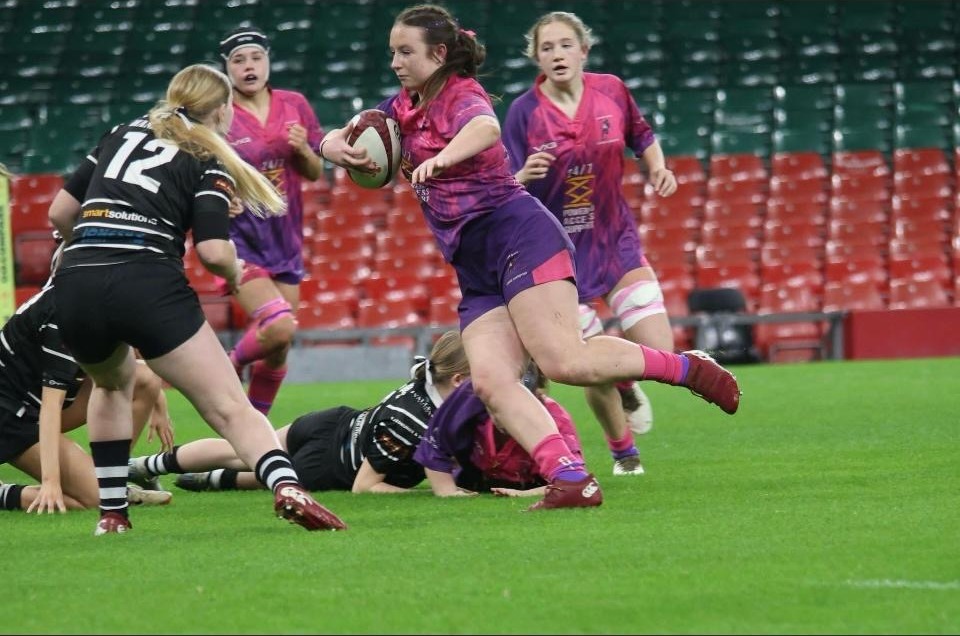
A 70-minute grassroots club session, with a standard and an alternate option on every activity. This is a sample plan for Girls' Gainline, written for a typical midweek club night. It is coaching guidance, not medical advice. Adapt it to your numbers, space and the experience of your group. If in doubt, stay with the alternate option and build up.
Session at a glance
Age group
U14 girls (England Rugby U14; in Wales, the girls' U13–U14 band, roughly ages 12 to 14)
Theme
Handling under a little pressure, then safe tackle technique
Time
About 70 minutes (it will still work in 60–75)
Players
Written for 16–24; it can shrink or grow
Space
Half a pitch, or a rectangle of about 50m × 40m
Equipment
8–10 size 4 balls, 20 cones, 8–12 bibs, water. Tackle shields if you have them (useful, not essential). Mouthguards for any contact: World Rugby strongly recommends a custom-made mouthguard for training as well as matches, so follow that and your club's rules.
How to open the session
Say this, then leave it there
Every activity tonight has a standard version and an alternate option. Both count. Choose what you need today. You do not have to explain. If you want to swap options later, or take a rest, that is fine.
Do not ask why a player chose the alternate option, and do not keep a record of the reason. Treat both options as a normal part of training.
If a player takes a knock to the head
Recognise and Remove. Any player with signs or symptoms of concussion, or a suspected concussion, comes off straight away and does not take any further part in the session or return to play or training that day. This applies to training as well as matches. Concussion can happen without a knock to the head or loss of consciousness. Do not try to diagnose it. Suggest a medical check (a doctor or NHS 111 in the UK), and use a graduated return to play before any contact, with written medical clearance for the full-contact stage. World Rugby recommends a more cautious return for children and adolescents and sets a minimum of 21 days before they return to play, after they have completed an individualised rehabilitation programme. Research suggests girls and women can have longer concussion recoveries, so be patient. See the WRU concussion guidance and World Rugby Regulation 10, and check the latest from your own union.
U14 rules this plan follows
This plan is written for U14 girls in England under RFU Regulation 15 for the 2026/27 season, and the U14s Rules of Play in Appendix 8. The official Appendix 8 page is dated 31 July 2025 and effective from 1 August 2025, and is still the Appendix 8 linked from the 2026/27 Regulation 15 page. Please check that this is the version your Constituent Body is using, and look out for any local notes.
If you coach in Wales, follow the WRU Rules and Regulations (U7s to U16s) and the WRU Pathway Laws, not the RFU rules of play this sample is written to. In the WRU female pathway, U13 and U14 girls play in a two-year age band (roughly ages 12 to 14). Under the WRU Under 14 Pathway Laws, matches are two halves of up to 30 minutes, rather than the RFU U14 25-minute half. Check the current WRU pages before you use the contact or game blocks, or add scrums and lineouts.
The key points that shape this session (these first points are the England, RFU U14 rules; the Welsh differences are in the Wales note above and the last point below):
Maximum 15-a-side, with equal numbers. Ball size 4. Check Appendix 8 for the current match length. Pitch no larger than 100m × 70m, plus in-goal.
Only the ball carrier can be tackled. The tackler must grip and hold below the base of the sternum (the tummy or belly, or below), and the tackle must use the arms.
The ball carrier must not dip late and low, or put their head into the tackler's head space.
In a match, U14s have a contested eight-player scrum (the number 8 may pick up; the scrum may be pushed a maximum of 1.5m and is reset if it wheels more than 45 degrees) and an uncontested lineout with no lifting. This sample training game leaves those out on purpose, so a group with mixed experience can play safely. You can add them later when you have confident, competent players and enough numbers.
Kicking from hand, fly-hacks, box kicks, drop goals and kicks at goal are all permitted at U14. This session does not practise them, so the group can focus on handling and safe contact.
The official rules encourage coaches and match officials to reduce the playing level where that gives a safer or better learning opportunity. Rolling substitutions are permitted.
In Wales, the WRU Under 14 Pathway Laws give two halves of up to 30 minutes with no extra time, an eight-player 3-4-1 scrum with a maximum 1.5m push and no intentional wheeling (play stops if a wheel reaches 45 degrees), and the number 8 may pick up. For tackle height they point to the World Rugby tackle-height directives. Since 1 July 2026 World Rugby law lets each union choose the waist or the base of the sternum as the community tackle limit. This plan uses the base of the sternum as the highest point, which is what Wales adopted in 2023. If your union or club uses the waist, keep every wrap at waist height or below. Check the current WRU page for the 2026/27 season.
Sources: RFU Regulation 15 and Appendix 8, U14s Rules of Play. If you coach in Wales, use the WRU regulations and Pathway Laws linked above, which differ in places from these RFU rules. If you coach elsewhere, or your county has issued its own summary, check those rules before you use the contact and game blocks. Scotland and Ireland also have their own unions.
Running order
0–3Welcome, names if needed, and the 'choose your option' message
3–18Warm-up, based on the RFU Activate U13–U14 structure
18–32Skill block 1: catch, pass and a little evasion
32–48Skill block 2: safe tackle technique
48–64Conditioned small-sided game
64–70Cool-down, a short circle chat, and thanks
Warm-up, based on RFU Activate (15 minutes)
Use the official Activate programme for your current phase if you have the cards or videos — that is always the best version. It comes from the RFU (U13–U14 cards) and is also on World Rugby Passport (Under-15, age 13–15, four levels, each with parts A to D, about 15–20 minutes). Either is fine for Welsh clubs. The block below follows the same four-part shape (running and change of direction, balance, bodyweight strength, then landing and cutting) so you can still run a good 15-minute warm-up if the cards are not to hand. Quality of movement matters more than speed. englandrugby.com/run/player-welfare/activate · World Rugby Passport Activate (Under-15)
A. Running and change of direction (about 3 minutes)
Mark a channel about 15m long and 8–10m wide. Players travel down and back in ones or twos, leaving a sensible gap.
Standard option
Easy jog down, jog back. Then a gentle swerve, changing from left to right as they go. Then a side shuffle one way and a controlled cut back the other. Stay tall, with the knee over the toes when they change direction.
Alternate option
Walk-jog instead of a continuous jog. Smaller, slower changes of direction, or a straight walk-jog with no cuts. If a sharp plant feels sore, they stay with a straight line.
Coaching points. Chest up. Soft feet. Hip, knee and ankle in line when they turn. No racing.
Diagram: Running channel
Keep the channel clear of bags and posts. Two groups can use two channels if you have the space.
B. Balance (about 3–4 minutes)
Players spread out in the same area, each with enough room to stretch their arms.
Standard option
Balance on one leg for 15–20 seconds, arms out, then swap legs. If that is steady, add a small hop on the spot and stick the landing on the same leg, three or four times each side.
Alternate option
Balance on two feet, or keep a toe of the free foot lightly on the ground. Hold a cone, a partner's hand, or a post for support. Skip the hop and just hold a steady position.
Coaching points. Eyes on a point in front. Stand tall. The standing knee stays soft, not locked, and in line with the toes.
Diagram: Balance spacing
Coach walks the group and looks for knees collapsing inwards. Offer the supported option without making a fuss.
C. Bodyweight strength (about 5–6 minutes)
Still in the same spaces. Bodyweight only. About six to eight careful repetitions of each exercise, or a short hold.
Standard option
A comfortable squat, heels down, then stand. A front support (plank) on hands or forearms, body in a straight line, for a short hold. A glute bridge, hips lifted and lowered with control. A slow calf raise. Then static neck contractions: hands on the forehead and then each side of the head, push gently into the hands while keeping the head still, and hold for about 10 seconds in each direction.
Alternate option
A shallower squat, or sit-to-stand from a bench or a kit bag. Plank with knees down. Bridge with a smaller lift. Fewer repetitions, or skip any exercise that feels uncomfortable and stay with the ones that do not. For the neck work, push lightly and hold for a shorter time, or skip it.
Coaching points. Slow and tidy beats a wobbly extra rep. Breathe. If the lower back starts to sag in the plank, stop and reset, or move to the knee version.
Diagram: Strength layout. Same scattered spacing as the balance work. Coach demonstrates one exercise at a time, then the group follows. This is preparation, not a fitness test. Praise control.
D. Landing and cutting (about 3–4 minutes)
Back to the 15m channel, or a slightly shorter one if the surface is uneven.
Standard option
From a short step or a very small jump, land on two feet and stick for two seconds: quiet feet, knees soft and in line. Then a controlled 45-degree cut on the coach's call, left and right, walking back to the start each time.
Alternate option
Step and stick with no jump. Or walk the cut, concentrating on knee line, with no change of speed. A player can also watch and coach a partner's landing instead of jumping.
Coaching points. Land quietly. Knees in line with toes, not collapsing in. Chest up. If a landing looks heavy or twisted, slow it down or switch to the step-and-stick option.
Diagram: Landing channel
Activate is there to reduce injury risk, including around the knee. Unhurried, well-lined landings matter more than height.
Skill block 1: catch, pass and evasion (about 14 minutes)
Grid passing, then a defender
Mark two or three 12–15m squares, depending on numbers. Four or five attackers in each square, one ball per square, size 4. After a few minutes, add one defender in a bib.
Standard option
Attackers keep the ball alive with two-handed catches and passing off both sides, moving into space. When a defender is added, they start with a two-handed tag only. If the ball is tagged, the attacker has three seconds to pass. Keep it continuous. Swap the defender often.
Alternate option
Unopposed passing in the same grid, at a walk or an easy jog. A player can be a feeder on the edge of the square, or take a rest and come back in. If a defender is too much, stay unopposed or let the 'defender' only shadow, with no tag.
Coaching points. Hands up early. Catch with two hands. Pass to where the receiver is going. Small steps, not a wild spin. Communication: call for the ball. If the pass is poor, reset quickly and go again — no long inquests.
Diagram: Passing grid (one square)
Use two or three squares so nobody is standing in a queue. If you only have 10 players, use one square and keep changes frequent.
This block stays tightly in line with the U14 tackle law: wrap below the base of the sternum, use the arms, and keep heads out of each other's head space. Start slower than you think. Only go to ground if the technique is tidy and both players are comfortable. Mouthguards on for this block. World Rugby strongly recommends them, and most clubs expect them. Keep contact within the week's limit: RFU age-grade guidance suggests no more than 15 minutes of full-contact and 30 minutes of medium-intensity contact training per week, so count any other training and matches this week. This is guidance, not regulation. If you can, add one or two Contact Confident activities (rolling, falling and landing, neck work) before the tackle work: World Rugby Contact Confident.
Approach, wrap and (if ready) a controlled tackle
Mark two or three corridors about 8m wide and 10–12m long. Work in pairs, or a ball carrier plus a tackler, with a short queue at each corridor. If you have shields, use them first. Then, if the group is ready, move to a partner who is expecting the contact.
Standard option
Ball carrier jogs forward holding the ball in two hands, slightly to one side. Tackler approaches in a balanced stance, drops their height late but not by diving, wraps with both arms below the base of the sternum, cheek close to the hip, and completes the wrap. First few goes: wrap and hold, stay on feet. Then, if both are happy and the wrap is safe, a gentle take to ground. On the ground the tackler releases and gets up; the ball carrier places or passes. Then swap roles.
Alternate option
Walk-through wraps on a shield, or a standing wrap-and-hold with no take to ground. Or shadow the tackle beside a partner, matching footwork and arm position without contact. Or be the ball carrier who presents the ball and makes a clear pass, with no role as tackler this time. All of these count as full involvement.
Coaching points. Eyes up, then wrap. Arms must be part of the tackle. Contact is on the tummy or below, never around the neck, chest or head. Ball carrier stays tall — no late dip, and no head into the tackler's head space. After a tackle to ground, release and get to your feet before competing for the ball. If a wrap rides high, stop the pair, reset, and try again more slowly. If anyone looks unsure, stay with the alternate option.
Diagram: Tackle corridor
One pair at a time in each corridor. The coach stands close enough to stop an unsafe attempt. No charging, no tackling a player who is not expecting it, and no tackling in the queues.
Conditioned game (about 16 minutes)
Small-sided game, equal numbers
Play 5v5 or 6v6 on a pitch about 40m long and 30m wide, size 4 ball, bibs on one team. Use two or three mini-pitches if you have the numbers, rather than one big game with lots of waiting. Rolling substitutions so everyone gets a fair go. Restarts: a free pass from the coach or the scoring team, five metres out, to keep the game moving. No scrums or lineouts in this sample game.
Standard option
Two-handed tackle below the base of the sternum, as practised. If the earlier block has gone well, a controlled take to ground is allowed. After a tackle, the tackled player places or passes quickly (the coach can call 'use it'). A try is a grounding on or behind the try line. Keep the ball in hand — no kicking in this game, so more players touch the ball.
Alternate option
Tag or a two-handed wrap only, with no take to ground. Or play in a marked 'no-contact' strip down one side, where a two-handed tag is enough. Or rotate off for a rest and come back on. A player can also be an extra support passer, who can receive and give a pass but is not tackled.
Coaching points. Equal numbers on each team. Stay with the tackle law: below the sternum, arms on, heads safe. Celebrate a good decision to pass as much as a try. If contact gets messy, blow it up, bring the group in, and drop back to wrap-or-tag only. Coaches stay out of the play while the game is live: stand at the side with a whistle ready to stop play, and coach in the breaks.
Diagram: Mini-pitch
Shrink the pitch if you have fewer than 10 players in the game. Leave a 5m gap if two mini-pitches sit side by side.
Cool-down (about 6 minutes)
Ease down and a short circle
Walk the width of the area, then come into a circle.
Standard option
Easy walk, then a slow side-step. Gentle stretches the players already know — calves, thighs, hips, shoulders — each held comfortably, no bouncing. In the circle, ask two quick questions: what felt good, and what shall we take into next week? Thank them for looking after themselves and each other.
Alternate option
Walk only, or stretch sitting or standing, whatever is comfortable. A player can listen in the circle without stretching, or take a drink and join the last minute of the chat.
Coaching points. This is a calm finish, not an extra fitness effort. No stretching into pain. End on something specific and kind, and repeat that both options tonight counted.
Diagram: Cool-down circle. Walk the width once or twice, then a loose circle around the coach. Keep the conversation short so people can get warm and go home on time.
If numbers, space or energy are short
Fewer than 12 players: use one passing grid, one tackle corridor, and a 4v4 or 5v5 game on a smaller pitch.
A wet or hard surface: keep landings as step-and-stick, and keep the tackle block to wrap-and-hold or shields.
A group new to contact: stay with the alternate options in the tackle block and the game. That is still a good U14 session.
Mixed experience: pair a more experienced player with a less experienced one, and let either choose the alternate option.
Please check before you use this
The current RFU Regulation 15 and Appendix 8 for your season, and any notes from your Constituent Body. Local summaries sometimes add detail (for example on scrum push, brake foot, or kicking).
Your club's safeguarding, first-aid and mouthguard rules, and whether a first aider is present for contact work. In Wales, the WRU requires the coach to hold the WRU Level 2 award for U14s.
The official Activate cards for your current phase (RFU U13–U14, or World Rugby Passport Under-15), if you have them.
If you are not in England or Wales, the rules of your own union, which may differ.